What to Watch: "Teenage Sex and Death at Camp Miasma"
Gillian Anderson and Hannah Einbinder go on a voyage of personal discovery in Jane Schoenbrun's new movie, and it's a hell of a ride.

I’m coming to “Teenage Sex and Death at Camp Miasma” (⭐ ⭐ ⭐ ⭐, in theaters) a few weeks after its theatrical release, which I now regret because the movie isn’t just one of the better entries of the year but also a great leap forward for filmmaker Jane Schoenbrun after the indie/Gen-Z splashes of “We’re All Going to the World’s Fair” and “I Saw the TV Glow.” Plus, the conversations around “Teenage Sex and Death” have been many and fierce, which is gratifying, because it’s the kind of film you want to (and need to) have conversations about. It is, as the kids say, a rich text.
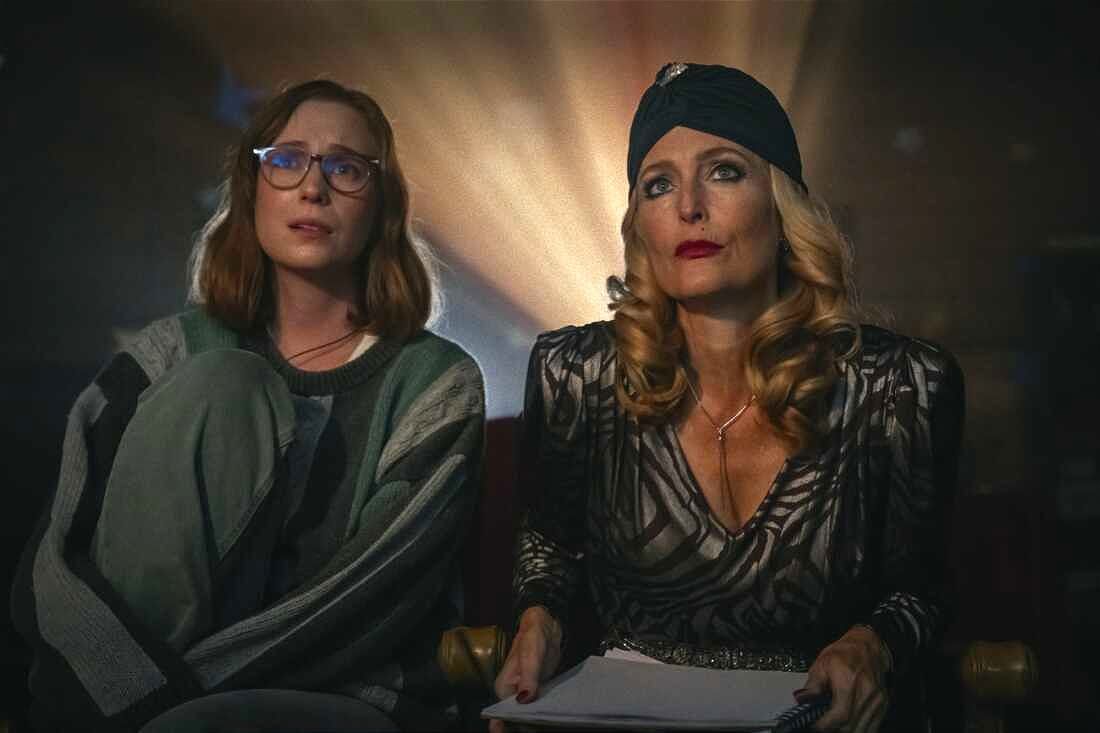
What it’s not is another wink-wink meta-horror movie – God knows we’ve had enough of those. (Those want to scare you; this one wants to heal you.) Instead, Schoenbrun has reverse-engineered the genre to personal ends, with a great deal of humor, heart, clarity, sorrow, radical notions and goofball craziness. And they’ve gotten two remarkable performances from Gillian Anderson and Hannah Einbinder, the former playing a cross between Norma Desmond and Laurie Strode (Jamie Lee Curtis’s character in the original 1978 “Halloween” as well as the most recent installments) and the latter a stand-in for the director and a proxy for the audience in all our carnal quandaries.
Einbinder, who you know as Jean Smart’s foil in TV’s “Hacks,” plays Kris Williams, a young director with an arthouse hit under her belt who’s been hired to reboot the 1980s Hollywood horror franchise of the title; after four decades and way too many sequels (neatly summarized in the opening titles), the series is lying dormant, and the studio hopes that a hot queer filmmaker will be able to bring it back from the dead while purging aspects of the material that are too politically incorrect for 2026 (like a trans killer, for one). Seeking inspiration and maybe some kind of consent, Kris drives to the middle of nowhere to visit actress Billy Presley (Anderson), the “final girl” of the original “Teenage Sex and Death at Camp Miasma” who vanished from the public after that first film and has been living ever since as a recluse at the backcountry summer camp where it was filmed.
I don’t know that Anderson has ever had this much fun on screen, gracing Billy with a Tennessee Williams fryolator accent, a Gloria Swanson turban, and a raging ambiguity as to whether her character is as crazy as a bedbug or the sanest person in the movie. Kris shows up at the snowed-in summer camp bearing all sorts of over-intellectualized interpretations of the “Teenage Sex and Death” brand, which Billy gently puts to rest by explaining that, honey, the only things those movies are about are “flesh and fluids.”
Which, in the cosmology of Jane Schoenbrun and the overripe subtext of this movie, is the same as saying “desire and release.” The director is a trans woman who transitioned fairly late, and their first two films openly wrestle with identity – gender and otherwise – as it’s filtered through the gnarlier corners of the Internet and popular culture. (“We’re All Going to the World’s Fair” was about a secret online game that transformed its players, and “I Saw the TV Glow” concerned a “Buffy the Vampire Slayer”-style cable series that forged a mysterious bond between two social outcasts.) “Teenage Sex and Death at Camp Miasma” feels like Schoenbrun’s breakthrough because the wrestling, in a sense, is over. The movie’s about accepting oneself – one’s gender, one’s sexuality, one’s groaning burden of guilt, all of it – as a screwed-up combination of everything inhaled from a junk-food media culture and our own messy experiences of growing up in sex-obsessed Puritan America and then exhaled as a permission to just … be.
If that involves blurring the lines between sex and death, lust and fear, coming and going, well, fine, you can always untangle them later. Anyway, horror franchises like “Halloween,” “Friday the 13th” and “Nightmare on Elm Street” have traditionally muddled the two to great profit, since nothing makes an adolescent nervous system light up like Times Square than the prospect of violent imminent dismemberment or nookie. And so “Teenage Sex and Death at Camp Miasma” – the horror movie within the movie – is a baroquely funny Rorschach blot of repressed psycho-socio-sexual urges, with a summer-camp killer called, uh, Little Death who wears a ceiling ventilator as a helmet and carries a double-edged spear that even Sigmund Freud might think was a little much.
Schoenbrun emphasizes the “camp” aspects of the title with blood-letting that’s comically bogus, and yet they also erase the border between VCR-era genre cheese and the reality that Kris and Billy find themselves in as they’re drawn closer together and the older actress starts getting under the skin and suppressions of the younger filmmaker.

I said that Gillian Anderson is having a high old time here, and she is, but this is the film that made me realize that Hannah Einbinder may have the stuff of greatness under that deceptively lackadaisical pretty-plain exterior. A scene in which Kris takes a Zoom meeting with the studio execs in her car is a bravura piece of gonzo performance, Einbinder shuttling between excitement, panic, conspiracy-mongering and the pure delight of letting go, and the bamboozlement on the faces of the suits is priceless. The sequence is a nervous breakdown as performance art.
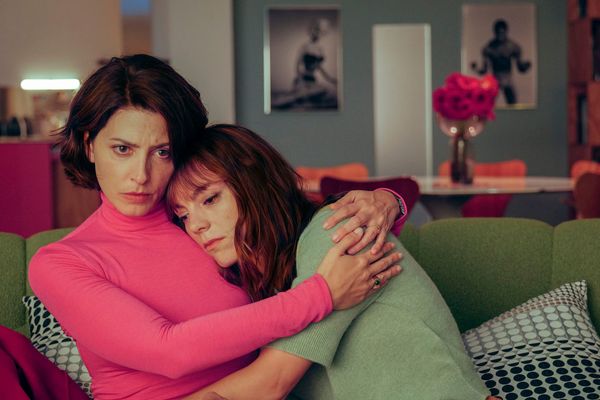
When we first meet her, Kris is hiding behind her oversize glasses, stilted intellectual rigor and modish Brooklyn relationships – she’s in a not very satisfying throuple and tells Billy she’s poly. (The older woman responds, “Polly who? Oh, we used to just call that cheating.”) Under Billy’s goading, Kris begins to unravel the taboos that have hamstrung her since childhood, and Einbinder lets us see the hope rising to the surface of her character’s face in ways that just about break your heart. It’s the promise of freedom from the cages we build for ourselves.
Indeed, the flip side of that release – and “Teenage Sex and Death at Camp Miasma” is very much a movie about release in all its … fluidity – is imprisonment. One of Schoenbrun’s more emotionally powerful gambits is an operatic massacre sequence in the film within the film, cued to Counting Crows’ “A Long December” and shot with the faceless Little Death (Jack Haven) at the center of the maelstrom until the perspective shifts just so, and for a brief moment we glimpse a young man’s sad, unseeing eyes in the middle of that ridiculous mask.
(Speaking of music, the score by the singer-songwriter/producer Alex G – his third time working with Schoenbrun – finds a satisfying midpoint between ‘80s horror synths and something more hauntingly modern, and the movie’s needle drops are superb. Extra points to the composer for drafting Paul Buchanan, the soulfully wracked voice of the long-lived cult band The Blue Nile, for one number.)
By the time “Teenage Sex and Death at Camp Miasma” gets to its outrageously funny and moving (and, okay, sanguine) endgame, it has reached a place far over the top yet just right, and don’t ask me to spoil it for you other than to say that few putative horror films, even the faux ones, send you out as happy as this one does. I repeat: You don’t have to be a fan of the genre – or even like to be scared at the movies – to enjoy “Teenage Sex and Death at Camp Miasma” or follow along on its satisfying emotional stations of the cross. But you do have to be open to the notion that nothing’s more terrifying than the killers we carry inside us and the ways they keep our truest selves held hostage in the basement.
I know a lot of my readers won't think this is their kind of movie, but it kind of is. Tell me about a film that blew your doors off after you went in cold or expecting nothing much.
You can read the Watch List for free (much of it), but I don't do it for free. Becoming a paid subscriber helps me keep providing you with good movies to see, cultural commentary, subscriber-only extras and various thoughts to chew on. Plus you can talk back and give me what-for.