"NAZA": The Executioners' Songs
A chilling documentary on the genocide in Gaza holds a mirror up to a nation's illusions.

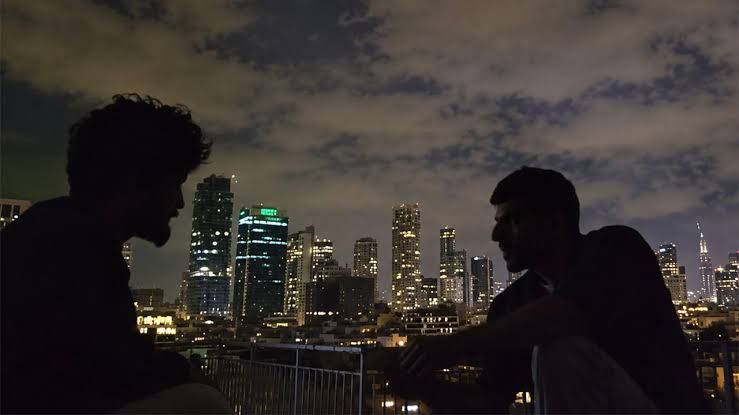
In the devastating new documentary “NAZA” (in theaters, ⭐ ⭐ ⭐ ⭐), twenty-four Israeli soldiers and intelligence officers – most of them men, as far as I can make out – sit on a nighttime rooftop high above Tel Aviv. Their features in shadow and silhouette, their voices altered, they tell director Yuval Abraham of atrocities they have witnessed and committed. Here are some of the things they say:
“The ‘human shield’ claim about private houses is absurd. They just come home to sleep. That’s where we find them.”
“The goal was quantity not quality.”
“The policy is to destroy everything as quickly as possible, before we lose international legitimacy.”
“Whoever you decided to kill was a terrorist.”
"It’s like a video game, we’d always say, because everything is done remotely.”
“When we would attack someone and saw he was injured but alive, we usually dropped another bomb on him.”
“There was a boy who entered our territory, he wasn’t doing anything. They bombed him.”
“I heard a woman screaming that her daughter’s body was burning.”
“We didn’t collect the bodies. The dogs eat them.”
(Asked if what’s happening in Gaza is genocide.) “Yes. Completely.... It’s intentional killing. We intended to kill those children.”
Abraham and Rachel Szor, the directors of “NAZA,” were part of the team that made “No Other Land,” the 2024 Best Documentary Oscar winner about the bulldozing of the Palestinian villages of Masafer Yatta by Israeli forces. “NAZA” received a 24-minute standing ovation at the Venice Film Festival this September and was immediately attacked by the Netanyahu government. Culture minister Miki Zohar accused the filmmakers of treason and Netanyahu himself has called for the revocation of Abraham and Szor’s Israeli citizenship. A week after the Venice premiere, right-wing crowds surrounded Szor’s parents’ home in central Israel demanding the directors be put to death.
Go to social media and under discussions of “NAZA,” you’ll see angry commenters attacking the movie using the same metaphor of a “distorted” or “warped” mirror. Whether or not that’s coordinated in any way, it speaks to a fury at being confronted with a reflection so at odds with a scrupulously maintained national and cultural identity that it becomes an existential threat.
Hit dogs holler, you might say, and there are more than enough blows in “NAZA” to enrage Israeli hardliners while appalling any and all viewers of conscience. (Which includes many Israelis and Israeli filmmakers, over a thousand of whom have signed a petition in support of Abraham and Szor.) The title is an Israel Defense Forces acronym for “collateral damage,” bland officialese for those men, women or children unlucky enough to be standing near anyone even suspected of being a member of Hamas when the bombs fall. The word itself is meant to absolve personal guilt on the part of those dropping the bombs. “We say 15 NAZA,” says one interviewee. “Not 15 people, or 15 women and children. We say 15 NAZA.”
Fifteen is a low count. We hear of strikes killing 20, 30, even 300 random Palestinians. One target – by which I mean one human being – had 13 NAZA according to the man who killed them. “I heard his kid watching TV. But what can I do about it?” Another interview subject claims “there was approval once to kill 500 for one human target.”
Was it personal? Yes and no. Many of the men interviewed speak of the 2023 massacres of 1,200 Israelis as a calamity that filled them with blanket rage for all Palestinians. “After October 7th,” says one man, “everybody said there are no innocent people in Gaza,” a conviction he saw take hold across the IDF. The goal was “to destroy,” and that righteous anger became bureaucratized into a state-sanctioned mass assassination program, supported by an Orwellian surveillance network that catalogued every single apartment building in Gaza and could listen in on every Palestinian’s phone call.
The intrusion was so total that intelligence officers were able to hack into the cell phone of one suspected terrorist’s 12-year-old daughter to find out when her father would be coming home, using artificial intelligence to sift her conversation for the words “daddy” and “return.” (Did you kill the 12-year-old girl too? wonders Yuval. “That’s right,” he's told.)
We hear that an artificial intelligence program called Lavender was used to mark targets by their phone numbers, and that having AI decide who to bomb was better than “someone whose friend was killed by Hamas last week.” Lavender marked tens of thousands of phone numbers and resulted in “hundreds if not thousands” of deaths. It was “a perfect task for machine learning,” one man says, adding that Israeli personnel earned points on a score sheet for each supposed Hamas member bombed. “Gaza became a factory of targets… it was done on a mass scale, efficiently, like in a factory.”
Hearing such words, a viewer may feel history collapsing in on itself.

Aside from brief snippets of archival footage, the filmmakers don’t stray from that darkened rooftop. We just hear the men describe their jobs and the deaths they have brought about while wrestling with their consciences to one degree or another. ("I still see Nazis as evil, but what does that mean I am?" asks one, and the question isn't rhetorical.) The simplicity of the format in "NAZA" – its visual restraint, Abraham's quiet probing – is the source of its art, forcing a viewer to "see" the violence these men describe. The film's most chilling visual gambit may be when Abraham and Szor’s camera drifts out over the nightscape of Tel Aviv, peering into high-rise windows to glimpse middle-class Israelis going about their evenings while their TV screens blare the news the government wants them to hear. Gaza and Tel Aviv are less than 40 miles apart, but the compartmentalization is complete. Only at the very end of "NAZA" do we see footage from Gaza itself: A man crying out for his son and daughter buried under a bombed apartment building and an image of arms and legs protruding from rubble.
A few days ago, a counter-documentary, “NAZA: The Real Story” surfaced on the Internet. Created by right-wing political candidate Lt. Col. Toi Danino, “ultra-nationalist influencer” (per Variety) Ariel Averbuch and Hagai Gutman, it's available at the deceptively-titled website nazadocumentary.com. I haven’t yet watched it; the directors of “NAZA” released the following statement Thursday: “We are aware that the Israeli government has been promoting a film hosted on a website that initially – and falsely – claimed it was Yuval Abraham and Rachel Szor's documentary. This was a brazen attempt to mislead audiences and distract from the urgent questions raised by ‘NAZA.’ The real version of ‘NAZA’ is being screened in cinemas around the world in more than 50 countries, and will be freely available at theguardian.com in late November."
In an interview with The Jewish Journal, "Real Story" co-director Gutman calls “NAZA” “a blood libel” and talks about how offended he was by Abraham and Szor’s calumny against “the most moral army in the world.” And there’s the tautology behind the blindness, right there. The most moral army in the world can’t be capable of atrocities against innocent people because it’s by definition the most moral army in the world, so therefore those people aren’t innocent, they can’t be innocent, because the IDF is the most moral army in the world, so therefore everything the IDF does is justified as a moral act.
This is the logic underpinning a modern banality of evil. If that phrase strikes you as obscene in this context, it’s meant to be.
“NAZA” also bears witness to the wholesale inversion of reason necessary in those intent on building a religious state on a framework of neurotic machismo, as are all theocracies, or most. (I’m willing to cut the Dalai Lama some slack here.) This applies to any society convinced God is on their side, which is to say that Benjamin Netanyahu, Mojtaba Khamenei and Pete Hegseth are more alike than different.
Nor, as the filmmakers have pointed out in recent statements, are my hands or yours free of this movie’s stain – not as long as our taxes help pay for the weaponry that has killed 73,000 Gazans in three years. As I watched “NAZA” in a fugue state of horror, the title of Omar El Akkad’s 2025 National Book Award winner on the genocide came to mind: “One Day, Everyone Will Have Always Been Against This.” “NAZA" brings that day closer, as well as the long-overdue personal and national reckoning it calls for. Many people will shy from the reflection. But that’s what mirrors are for.
"NAZA" is playing in the Boston area at the West Newton Cinema and the Alamo Drafthouse.
I'm sure you have thoughts about "NAZA," whether you've seen the movie or not. Something tells me you're not going to be shy about it, either. So let's have it.
You can read the Watch List for free (much of it), but I don't do it for free. Becoming a paid subscriber helps me keep providing you with good movies to see, cultural commentary, subscriber-only extras and various thoughts to chew on. Plus you can talk back and give me what-for.