Ann Hornaday 1960 – 2026
Some thoughts on the passing of a movie critic and a friend.

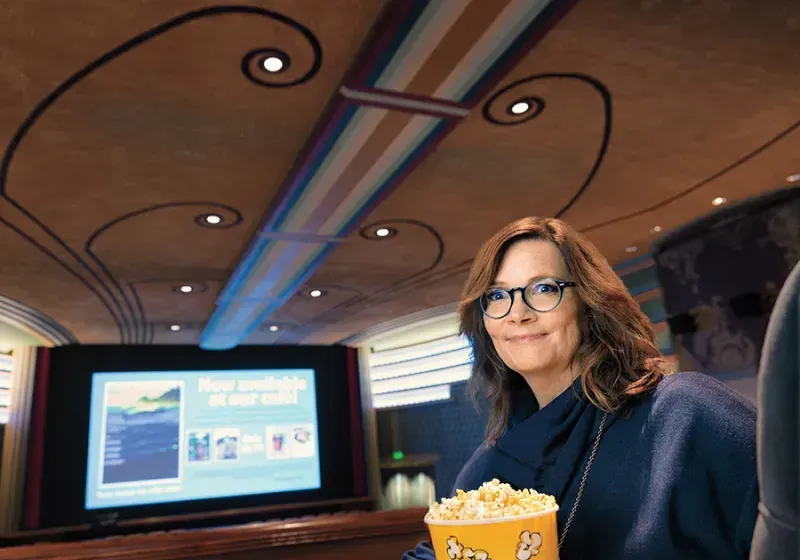
There are movie critics who bluster and movie critics who bitch, movie critics in love with the sound of their own voices and movie critics who want you to know they know everything. There are movie critics who kvell about all the movies they’ve seen and movie critics who’ve never met a movie they liked. I could include links here, but that would be rude (and, besides, at least half of them would point back to me).
Then there was Ann Hornaday: Sensible, sensitive, measured, funny, reliable. Knowledgeable without being obnoxious about it. Clear as a bell. And compassionate, which I’ve always felt was the one missing ingredient in so much writing about the movies. Here’s a passage from Ann’s 2023 essay on the films that had meant the most to her over the course of her life, as a critic, a moviegoer, a woman and a human:
In 2010, while millennials and young Gen Xers were rocking out to “Scott Pilgrim vs. the World,” British writer-director Mike Leigh released “Another Year.” By then I had turned 50, the ideal age to appreciate Leigh’s bittersweet group portrait of a long-married couple and the family and friends who drift in and out of their lives. (Lesley Manville delivers a bravura portrayal of a single friend whose loneliness becomes more achingly palpable with each faux-cheerful swig of wine.) It was as if the great hangout movies of the 1990s had aged gracefully into a narrative with the same observant wit, but one tinged with more melancholy, more hard-won generosity, more clear-eyed honesty about how some lives manage to rumble along happily, while others derail.
That’s the sound of someone who loves movies but who knows that life is more important – that the very best films point us back to the pains and ecstasies of being alive and, indeed, exist to help us make sense of them. “Of all artistic mediums,” Ann once wrote, “cinema occupies the trickiest space between fabrication and reality, exploiting the porous nature of both to become a third thing entirely: the distortion of the literal truth that becomes internalized as consensus history.” In other words, a falsity that helps us negotiate the actual. Which I guess would be a working definition of art, period.
Ann died last week at 66 of glioblastoma, a cancer of the brain. Excuse me, a motherfucking cancer of the brain. She was 66 and had recently completed work on a history of the 1976 Alan J. Pakula film “All the President’s Men” – a fitting project for a film critic of more than two decades standing at The Washington Post. It is expected to be released posthumously. (Her first book, 2017’s “Talking Pictures,” remains one of the more elegant explications of how the movies work – and how and why they sometimes fall short.)
I’m skirting the horrible medical banality of Ann’s death because I’d prefer to talk about what she did with her life rather than the way she left it. I was lucky to count her as a friend – not as closely as others in our tribe but as a charming, valued companion at film festival screenings and meals in between. More serendipitously, I had the honor of stepping into Ann’s shoes as the Washington Post’s movie reviewer for the two years she was out writing her book and then again in the early days of her illness, before the Bezos regime axed the paper’s freelance budget and turned the op-ed section into a lickspittle.
During that time, Ann and I shared an editor who was (and is) a great friend, and I briefly got to share in the readership of devoted Hornaday fans, who over the years had come to appreciate her writing and judgments as a trusted friend and who were kind enough, mostly, to tolerate a rank interloper in her place. To understand the depth of that relationship, you need only read the comments under the Washington Post’s obituary. Very few movie critics prompt that sense of loss.
In person, Ann was much as she was on the page: Engaging and engaged, curious, modest, very funny and a maybe little more mischievous than she allowed herself to be in print. Then again, maybe not. This is a critic who wrote of “Mamma Mia! Here We Go Again,”
“On paper the movie — a bright, poppy pastiche of jukebox anthems, vivacious production numbers and beachy backdrops — stands accused of being hopelessly corny, predictable and derivative. On the screen, it simply works, if only by pummeling the audience into submission with infectious joie de vivre.”
She wasn’t afraid to go against the critical tide. She was willing to take audiences to task for such entitled sins against the church of cinema as texting during a movie. She was brave enough to address the “tensions, contradictions and fleeting moments of grace I have experienced as a film critic who also happens to be a practicing Christian.” And as one of the few women in a male-dominated field, she had no problems addressing the inequities and misogyny of the society she lived in and of the films that society turned out. Some cultural pundits issue their pronouncements from on high. Ann was on the level.
In addition to the WaPo obit, others who knew Ann over the course of her career have been posting their remembrances online and elsewhere. I’m mourning a friend I wish I’d come to know better over the years as well as one of the best of a dwindling caste: The women and men who so love the movies that they dedicate their lives to writing about them and somehow manage to carve a career out of doing so, something that no longer seems possible in a world where traditional publications have abandoned the field and everyone has a Letterboxd account. Those of us who knew Ann Hornaday – and I include her readers in that group – feel the loss on a personal level. For those who didn’t, it's a harder thing to calculate. A voice has been stilled that saw things clearly and that, now gone, leaves a silence in its wake. If you didn't know it was there, you'll never know what you missed.
Feel free to add your thoughts about Ann.
You can read the Watch List for free (much of it), but I don't do it for free. Becoming a paid subscriber helps me keep providing you with good movies to see, cultural commentary, subscriber-only extras and various thoughts to chew on. Plus you can talk back and give me what-for.