TIFF Report II: "I Play Rocky,""Ink,” "Up Against It," "The Long Winter"
An underdog story about an underdog story is an unexpected highlight at the Toronto Film Festival

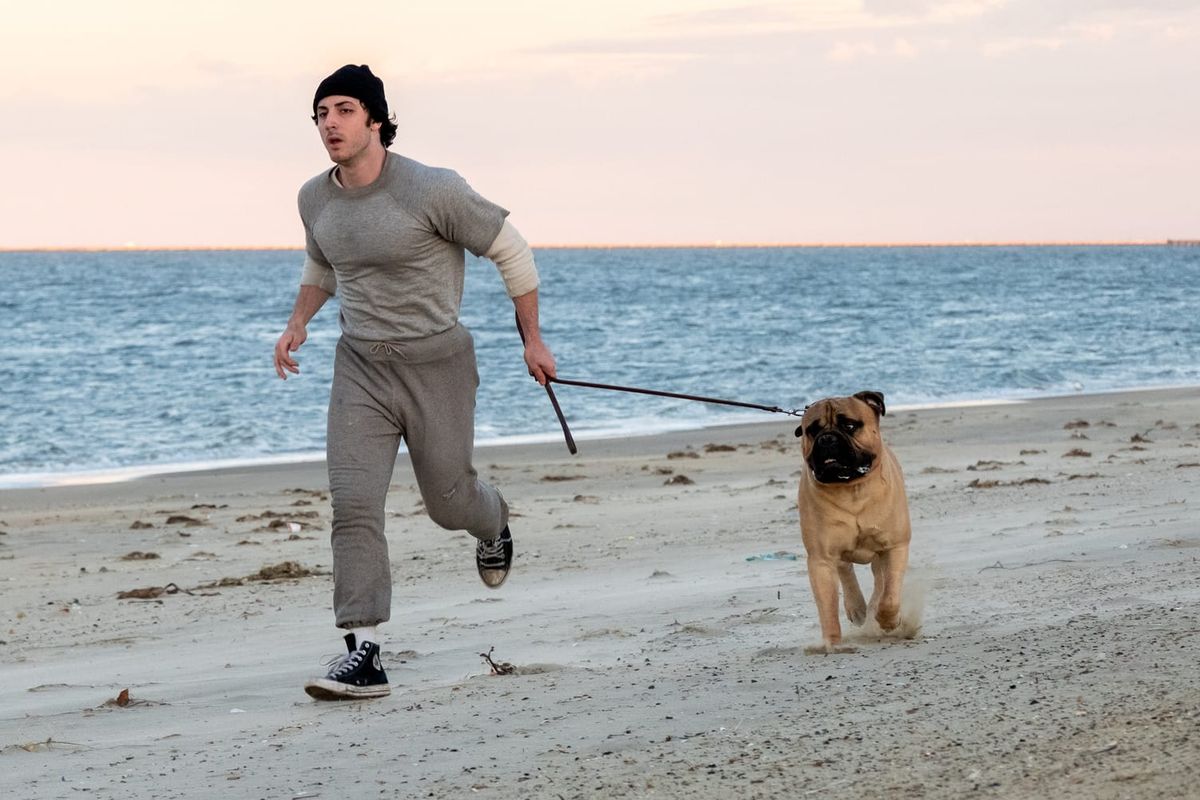
I went into “I Play Rocky” (⭐ ⭐ ⭐) with a fair amount of skepticism – the making-of-a-movie movie is getting close to played out, I was worried it might be a Stallone vanity project and I still haven’t forgiven director Peter Farrelly for “Green Book”. (You can read why at this Globe column I wrote after it won Best Picture while also enjoying the 172 splenetic reader comments below it.) But the new film’s an unexpected charmer. What puts it over is Anthony Ippolito's terrific performance as the young Sly Stallone – Ippolito played Al Pacino in the recent making-of-“The Godfather” series “The Offer,” so I guess he’s got a market niche now, but he disappears so completely into the skin of a person and a persona we know from fifty years of cultural exposure that within minutes I accepted him as the real heavy-lidded, marble-mouthed deal. (That skin, by the way isn’t the swole cartoon of 1980s-era Stallone, but a recognizably human body of a young, striving actor who does his share of planks and push-ups.) Ippolito recovers the human under the layers of waxy pop-culture build-up and reminds you of why the country fell for the guy in the first place.
The film begins in early ‘70s New York, mostly to establish how close to destitution the young “Mike” Stallone was living and to introduce AnnaSophia Robb as Sasha, the faithful girlfriend/wife in his corner. Then it’s off to Los Angeles and the meat of the movie: several failed screenplays, a few acting gigs, a day job as a car valet and, finally, a script inspired by watching washed-up boxer Chuck Wepner go 15 rounds with Muhammad Ali in a March 1975 fight. Independent producers Irwin Winkler (P.J. Byrne) and Robert Chartoff (Toby Kebbell) believe in the project but not when the kid insists [see title], and Stallone’s obduracy comes to seem nobly absurd as he turns down increasingly rich offers to step aside.
The back half of “I Play Rocky” concerns the actual 1975 production of "Rocky," which was shot on a shoestring in Philadelphia to stay clear of the New York unions. Writer Peter Gamble captures the trench-warfare camaraderie as everyone involved starts to realize this little boxing movie might actually be good. Again, the casting is sharp: Stevan James as actor Carl “Apollo Creed” Weathers; Jay Duplass brusquely pragmatic as “Rocky” director John Avildsen; an unrecognizable Matt Dillon as the star’s brutally caustic dad; and a lot of interesting lumpenfaces as crew members and Hollywood sharpies. (Michael Fuchs has a nice scene as cinematographer Garrett Brown, demonstrating a newfangled invention called the Steadicam on the steps of the Philadelphia Museum of Art. You probably know how that turned out.)
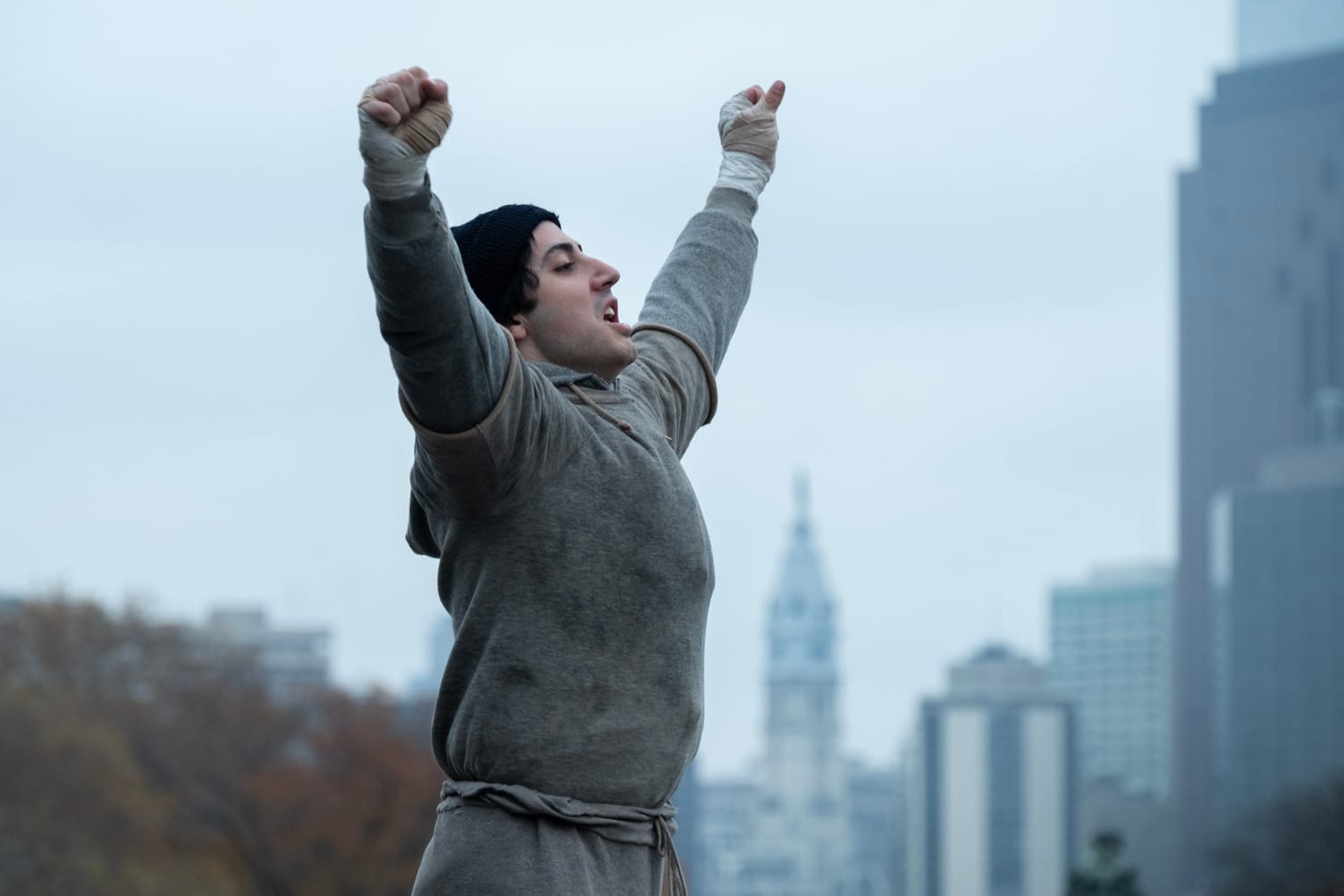
Is this how it actually happened? Yes, maybe, probably not; anyway, as the film's Stallone and Weathers cheerfully admit, actors tend to lie, and so do biopics. (Nowhere in sight: Craig Rumar and Larry Kubik, the agents who really did carry the “Rocky” script over the finish line and faithfully backed Stallone’s demand that he star.) Does it matter? Not while you’re watching this sweet, sweet slice of Hollywood self-mythologizing. “I Play Rocky” is an unapologetic crowd-pleaser from a director hardly shy about pushing buttons, but it’s genial, funny, and, okay, inspiring enough to make even a crabby old film critic allow his buttons to be pushed. Also, as one of my colleagues pointed out, Sean Porter’s cinematography mimics the angles, lighting and overall feel of the 1976 Best Picture winner to the point where you can practically feel the grain in the film stock and smell the cigarette smoke in the restaurant scenes. And it has Ippolito, who may be painting himself into a corner in much the same way Chadwick Boseman did at the start of his career but who may well have the goods – again, like Boseman – to become his own man. (In theaters November 6.)

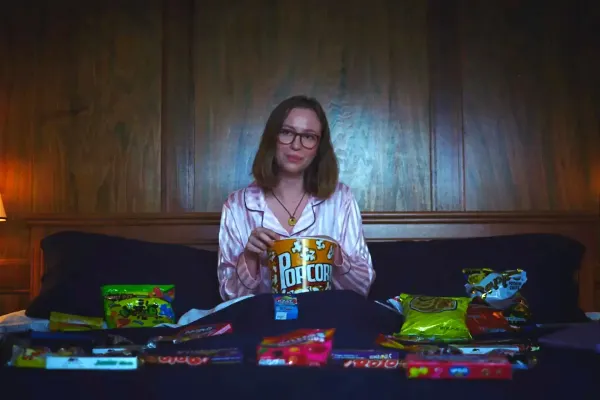
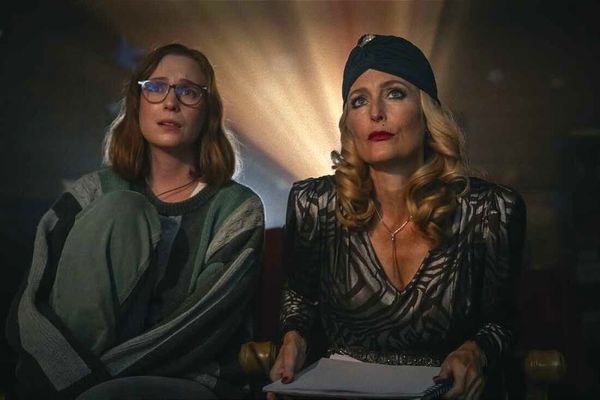
I went from the “Rocky” film to “Ink” (⭐ ⭐ 1/2), James Graham’s adaptation of his stage-play about the invention of the modern tabloid news era, with Guy Pearce as Rupert Murdoch and, at center stage, Jack O’Connell as Larry Lamb, the cut-throat Fleet Street editor Murdoch hired to take his newspaper, the Sun, from the bottom of the circulation ranks to the top. The magic formula is sensation and sex, much to the horror of London’s news-media peerage and much to the glee of Lamb and his staff (which includes Claire Foy as the reporter with whom he's carrying on a long-standing affair). The performances are fine – O’Connell is especially fierce – and the drama compelling, but I regret to inform you that "Ink" is director Danny Boyle movie at his most relentless Danny Boyle-ish, with cinematography that is stuck on permanent Dutch Angle and hectic over-editing that adrenalizes the story until it’s spinning like an out-of-control merry-go-round. All that directorial heavy-breathing becomes exhausting; more to the point, it gets in the way of the story. The coup de grace is a Ritalin-addled final montage of news footage that takes the movie from its Thatcher-era final scenes to our modern malaise and that blames the Sun for everything gone horrible in our society up to Trump, global warming, toxic masculinity and A.I. That might not be technically wrong but it comes off as glibly smug here. (Also, feel free to have qualms about trusting a movie where Rupert Murdoch comes off as the voice of sober-sided moral conscience.) (In theaters December 11, on Netflix January 9, 2026.)
Unfair Partial Review Dept. – I don’t know that I’ve hit the eject-seat button on a festival film as quickly as I did “Up Against It” (⭐ 1/2), a painful comedy-drama directed by Trudie Styler that mixes divorce farce, angry-teen-girl theatrics, projectile vomiting and cancer into one glutinous, off-putting mass. It stars Antonio Banderas and Eva Birthistle as the battling ex-spouses, who have to get back together and make another child for stem-cell harvesting when their teenage daughter’s leukemia resurfaces, and right there that’s some comedy gold. Eden Hamilton is quite believable as the 14-year-old daughter, which is to say she's intensely irritating and may be triggering for anyone who’s actually lived with a 14-year-old daughter. This might have turned into something halfway good, but I didn’t stick around to find out – I didn’t bail from “Up Against It” so much as it spat me out. (Theatrical release TBA)

“A Long Winter” (⭐ ⭐ ⭐) – I had this on my TIFF to-do list for semi-personal reasons: The star, Fred Hechinger, is the son of a friend from my Entertainment Weekly days in the 1990s, and it’s been enjoyable watching him rise through the ranks of bit parts and supporting roles to this, his first lead, while his mom kvells about him on social media. You know Hechinger as the awkward son in the first season of “The White Lotus” or as June Squibb’s hapless grandson in “Thelma”; here he’s in good company with Ebon Moss-Bachrach (“The Bear”) and Catriona Balfe (“Outlander”) as Mike, a young man watching his family come apart in the high mountains of Colorado in the 1950s. (The source is a Colm Toibin short story; Andrew Haigh, the talent behind “45 Years” and “All of Us Strangers” directs.)
It’s a three-hander, really, with Moss-Bachrach giving complex shades to his role as the rigid patriarch; Balfe as his wife, going around the bend from isolation and alcohol; and Hechinger as their son, coming to terms with his own repressed sexual urges while trying to decipher the mystery of his parents’ relationship. At a certain point, Balfe’s character disappears from the picture – the actress practically immolates herself as a vibrant woman on the verge of spiritual death – and father and son spend the ensuing months searching for her while family secrets keep turning up like corpses in the snow.
The movie looks gorgeous: Haigh uses the mountains of “A Long Winter” as a canvas for an Oedipal struggle that almost but never quite matches its epic setting, and the drama of Mike’s queerness – which he can barely put words to himself – never fully meshes with the larger domestic drama. It’s a solid movie nonetheless, with a unique figure in the lead: Where a lot of actors work hard to project strength or cool, Hechinger carries himself with an open-faced half-smile that evokes gentle vulnerability (and that oddly reminded me of the young Gene Wilder at times). Mama should be proud. (Theatrical release TBA)
Care to comment? Please do.
You can read the Watch List for free (much of it), but I don't do it for free. Becoming a paid subscriber helps me keep providing you with good movies to see, cultural commentary, subscriber-only extras and various thoughts to chew on. Plus you can talk back and give me what-for.