TIFF Report I: "All of a Sudden,""Minotaur,” "Wild Horse Nine"
A new Hamaguchi masterpiece, a brooding Russian drama and a peak performance from one of our great acting eccentrics.


Normally I don’t pick a three hour and 16-minute movie as my film festival palate cleanser, but the movie in question is from Ryûsuke Hamaguchi, and after “Drive My Car,” “Wheel of Fortune and Fantasy” (both 2021) and “Happy Hour” (2015), I would follow this director anywhere. “All of a Sudden” (⭐ ⭐ ⭐ ⭐) turns out to be Hamaguchi’s most conventionally ambitious film – notice I didn’t say conventional – in that it folds so much into its running time: Proper care of the elderly and our maddening Babel of languages; the lowering boom of terminal illness and the sustaining joys of female friendship; theatrical performance and group foot massage; talk and thought and action. On top of all this, there’s a big honking TED talk smack in the middle, whiteboard and all, about the systemic entropy built into Capitalism.
Damned if it doesn’t all work. In fact, it’s glorious.
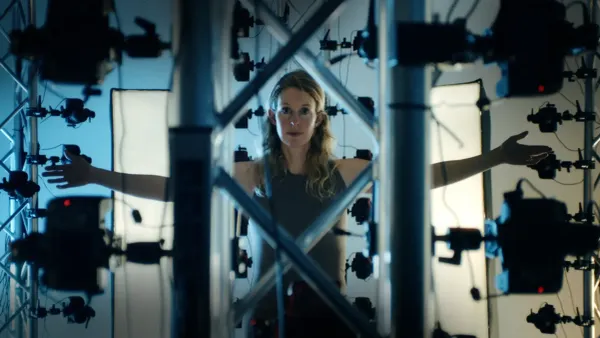
Set mostly in Paris, with a few side trips to Kyoto, “All of a Sudden” pivots around the twin suns of Marie-Louise (Virginie Efira), the director of an experimental Paris program for Alzheimer’s patients, and Mari (Tao Okamoto, who shared a Cannes Best Actress prize with her co-star), a young playwright who we quickly learn has Stage 4 breast cancer that has metastasized to her bones; she’s in decent health at the moment but waiting for the onset of sudden decline and determined to get as much living done while she can. The two first meet when Marie-Louise comes across Tomiko, the autistic grandson (Kodai Kurosaki) of Mari’s star actor, Gorô (Kyōzō Nagatsuia), wandering in public; a subsequent visit to a performance of Gorô’s one-man show – written by Mari and using the ideas of the radical Italian psychiatrist Franco Basaglia, who proposed and helped enact the abolition of mental hospitals in his country – leads to an all-nighter of walk, talk, ideas and profound connection.
Hamaguchi is one of those filmmakers, like Eric Rohmer, who’s able to make reams of dialogue bristle and flow with purpose and drama, and that long evening peaks in mid-movie when the playwright literally diagrams the ways a society built on the pursuit of capital is doomed to failure – to whittling our pursuit of time free from work down to nothing before inevitably collapsing. It’s a casual lecture, delivered from friend to friend, but it stuns a viewer with its accuracy: Mari is describing how most of us are living, right now.
That scene sounds like it should be deadly; instead, it’s alive with clarity and the excitement of seeing the big picture come into focus. And then “All of a Sudden” moves on, to the struggles Marie-Louise is having convincing backers and some staff members that her “Humanitude” program has worth, to Mari’s coming to terms with the use she can make of her final days, and to a resolution that hints at the film’s largest theme, which is the blurring and dissolving of the borders between patient and caregiver, actor and audience, sane and insane. (Not for nothing is Mari’s play titled “Up Close, None of Us is Normal.”)
Hamaguchi has loosely based his screenplay on a 2019 book titled “You and I – The Illness Suddenly Gets Worse,” a collection of letters between the anthropologist Maho Isono and the terminally ill philosopher Makiko Miyano. The elderly residents at Marie-Louise’s facility are real people living with Alzheimer’s and their presence in the film is immensely touching, even dignified. (One presumes their families have consented to their participation, and, indeed, some of the most powerful scenes involve family members calling up memories of the patients in their prime, for better and sometimes worse.) The actor playing Tomiko is really autistic, and he wanders through a movie that, likewise, has smudged its borders to allow him the freedom to be himself. The kindness of “All of a Sudden," its understanding of the immense power of human touch, flows through the scenes like an underground river.
It’s long, of course, with more than a few false endings, but each new sequence adds a further grace note. A churl might note that Mari’s striking beauty carries over to her final days and unto her death bed, marking her as perhaps the latest exemplar of that cinematic illness known as “Ali McGraw Mysterious Wasting Disease.” But the length and breadth and unexpected depth of “All of a Sudden” disarms churlishness. Among its other tributes and tributaries, I detected echoes of the French New Wave’s most wayward director, Jacques Rivette, in the rapport between two women that recalls our old friends Celine and Julie, in the use of theater as a stage where we can act out the subtexts of our lives and in the way Paris in the summer months breathes with an otherworldly lightness all its own. Three hours and 16 minutes and I was held suspended in rapture and empathy for every second of it. (“All of a Sudden” will be released theatrically by Neon on November 25.)

It was a good day for movies all around: My second screening was Andrey Zvyagintsev’s “Minotaur” (⭐ ⭐ ⭐), a prize winner at Cannes and a remake of Claude Chabrol’s 1969 film “La Femme Infidele” (which had already been remade in 2002 as “Unfaithful” with Diane Lane and Richard Gere). Again we follow a complacent businessman, Gleb (Dmitry Mazurov), as he uncovers evidence of the affair his wife (Iris Lebedeva) is having with a younger man (Yuriy Zavalnyouk); again, we are taken on a procedurally terse ride into Hitchcockian suspense and bad behavior. But “Minotaur” is set during the early days of Russia’s invasion of Ukraine, when orders are going out to local civic leaders to provide conscripts for the front, willing or not, and the hero’s slow, certain descent into moral depravity is as blisteringly political as it is domestic. Despite finely shaded performances from Mazurov and especially Lebedeva as a vibrant woman trapped in the jaws of a macho society, “Minotaur” is as subtle as a whack on the head (or two), which is both its strength as a broadside against a country that has forced the director into exile and a loss for anyone seeking the deeper, more mysteriously mythic waters of Zvyagintsev’s earlier masterpieces “The Return” and “Leviathan.” But I think he would argue that the time for ambiguity is long past. (“Minotaur” will be released theatrically by MUBI on November 20.)

I ended my first day at TIFF with a splendid bang: “Wild Horse Nine” (⭐ ⭐ ⭐ ⭐ 1/2, but that may go up a notch after I sleep on it), the latest dark comedic provocation from playwright-turned-filmmaker Martin McDonagh, who was last seen torturing Brendan Gleeson and Colin Farrow in “The Banshees of Inisherin.” This one feels in spirit like a throwback to McDonagh’s much-loved 2008 feature debut “In Bruges,” in that it’s a two-hander about a pair of argumentative fellows, both supposedly on the side of law and order, as they wander way out of their element. In this case, it’s two CIA spooks, Lee (Sam Rockwell) and Chris (John Malkovich), who are up to their armpits in dirty deeds in 1973 Chile. Allende is still the democratically elected Marxist president but not for long if Lee and Chris and their harried bureau chief (Steve Buscemi, in fine form) will have anything to do with it. (It’s clear that General Pinochet is waiting in the wings for the signal to commence.)
For reasons I won't spoil, our bickering anti-heroes are sent to Easter Island on a – I guess you would call it a mission of mercy. They wouldn’t. Chris is the elder of the two, a mentor to Lee, and it’s made clear that he got his hands dirty in Guatemala, Congo (“I liked Lumumba, but what are you going to do? Let him go?”) and other sites of covert US destabilization. (That one of those sites might be Dallas in 1963 is dandled like a second shoe you wonder if McDonagh is ever going to drop.)
As always with this writer-director, the dialogue is profane and very, very funny, a series of confusions, verbal contusions and escalating one-upsmanships that I could spend all night quoting. (Okay, just one: “Once you’ve tasted American cheese, you understand why we lost Vietnam.”) (Okay, one more: “I was killing people in countries before you were born. I was killing people in countries you can’t even spell.”) But if this hadn’t been set on Easter Island/Rapa Nui, I’d say it was awfully close to a filmed play.
Thing is, it is set on Easter Island/Rapa Nui (the two names come in for some jocularity early on), and the carpets of brilliant green dotted with those mysterious Moais – Chris just calls them “big heads” – pushes the dramatic action over the line into the eerily elemental. “Wild Horse Nine” doubles as a magnificent vacation to a place you and I will probably never go, and it’s worth the price of admission for that alone. But the abiding pleasure of the movie is John Malkovich. Rockwell is stalwart and not to be dismissed in what's essentially a slow-burning straight-man role, and for added inducement we get a brief glimpse of Tom Waits waking up in Monument Valley and an unrecognizable Parker Posey as Lee’s chippie of a wife. Few movies, however, have given one of our most eccentric great actors – he vies with Christopher Walken for the title – such freedom to play.
A man at the end of a long and filthy career, Chris is a happy loose cannon, goosed by morphine and a near-total lack of fucks to give, and he has decided to write a memoir that would be a disaster for the CIA if it ever saw the light of day. Malkovich reaches way down and finds the fury in this man, the gonzo absurdity and, more than anything, a sort of homicidal gentleness that makes Chris a danger to his colleagues and an unpredictable joy for an audience watching from the dark. Already there’s Oscar talk, blah blah blah – you don’t need a statue to appreciate this performance as a work of consummate creative professionalism from an actor who moves to a tune the rest of us can't hear. (“Wild Horse Nine” will be released theatrically by Searchlight Pictures on November 6.)
Have a comment? Let's hear it.
You can read the Watch List for free (much of it), but I don't do it for free. Becoming a paid subscriber helps me keep providing you with good movies to see, cultural commentary, subscriber-only extras and various thoughts to chew on. Plus you can talk back and give me what-for.