Apocalypse Yow: "Digger"
Alejandro Iñárritu and Tom Cruise go for baroque in a love-it-or-hate-it supersized satire.


It’s schadenfreude week on Rotten Tomatoes, and the critical long knives are out for “Digger” (⭐ ⭐ ⭐, in theaters), a movie that admittedly seems specifically designed to abuse a viewer’s patience. A galumphing satirical fantasia clocking in at just over two hours (which makes it practically a short subject in Oscar-season terms), it stars Tom Cruise under several metric tons of latex as oil baron Digger Rockwell, a whooping, potbellied good-ol’-boy who becomes singlehandedly responsible for an ecological crisis leading to the possible End of Civilization as We Know It. The movie's co-written and directed by Alejandro Iñárritu with garish panache, a heavy load of meta-narrative, a senescent mechanical cat and even less restraint, if possible, than “Birdman” and “Bardo,” the director's earlier forays into the extreme. The cast is a mosh pit of fine actors steered firmly away from subtlety: John Goodman as a gaunt President of the United States, dying from rectal cancer and turning in panic to Jesus and/or the nuclear football; Riz Ahmed as a fussy little government scientist who serves as the movie’s conscience; Michael Stuhlbarg as a craven Throttlebottom of a Vice President; Sandra Hūller with little to do but flex her umlaut as Digger’s CEO half-sister; Jesse Plemons in a red fright wig that turns him into a ringer for the late Brian Jones of the Rolling Stones. All this plus a VistaVision panorama of societal and environmental collapse that makes “Dr. Strangelove” look like a corporate retreat.

Okay, then. If this sounds like the latest big-budget auteurist Chernobyl along the lines of “Megalopolis” or “Babylon,” that’s certainly how a number of early responders are reacting to it. I beg to differ. Maybe I’m enough of a contrarian to feel that if a movie gets this much hate it must be doing something right. Maybe one can appreciate a cultural artifact as much for its wretched excess as in spite of it. The fact remains that, while one of my colleagues has reported that “Digger” “gave me hives” and another says she’ll never forgive the film for making her hate John Goodman, my own experience of was one of bug-eyed but mostly consistent enjoyment.
Sue me, I had a good time.
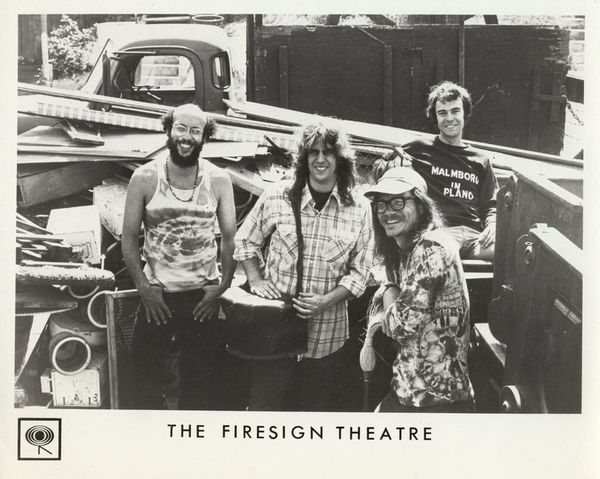
I might chalk that up to a longstanding love of circuses, cinematic and otherwise, or perhaps a too-early exposure to the work of the Firesign Theatre, the late-60s audio-comedy troupe whose LPs are Joycean in their density, Marxian in their silliness and Swiftian in their capacity to draw blood. (I still stake my lonely claim that the group’s 1970 album “Don’t Crush That Dwarf, Hand Me the Pliers“ is one of the greatest satires of American life and culture ever created in this country. For one thing – I’m paraphrasing the late Dave Marsh here – "Pliers" maintains that the U.S. actually lost World War II because we were supposed to be fighting Fascism, remember? If that wasn’t prescient in 1970, they should retire the word.)
“Digger” isn’t on that level, not even close, but in its exuberant embrace of doomsday chaos, it has a similar everything-and-the-kitchen sink aesthetic. And that’s not a bad thing. In fact, I’d argue it’s as American as apple pie and “The Day of the Locust,” “Singin’ in the Rain” and monster truck rallies. (Make that “the Americas,” since Iñárritu imbues the film with the feverish fecundity of a Mexican wall mural, only leached of color; the director has clearly given cinematographer Emmanuel Lubezki marching orders to mimic the ashen existential tableaux of Swedish filmmaker Roy Andersson as closely as possible.)

And, hell, what could be more American than Tom Cruise – Teflon Tom, our national Scientologist, the country’s second most notable couch enthusiast– finally choosing to act to the back rows with a performance that’s the equivalent of one of those shoot-the-works banana splits that no one ever actually orders. The centerpiece of “Digger,” after it becomes clear that climate Ragnarok has arrived and it’s all Digger Rockwell’s fault, is a sequence set in some kind of Roman senatorial chamber (where? why? who knows?) as a mob of angry ambassadors and lumpen-extras scream for Digger’s head. He responds with a furious cornpone soliloquy on the theme of mankind’s hypocrisy – how we’re all addicted to his oil and our fuel-driven comforts even as we lament the seas rising to drown us – and Cruise disappears beneath the man’s wattles and entitlement with a gusto that’s impossible to dismiss. Acting, I tell you – acting!
An aside: Decades ago, the star desperately tried to prove his artistic worth by appearing in films alongside cinematic gods like Paul Newman and Dustin Hoffman, to no avail. When Cruise finally was Oscar nominated for 1989’s “Born on the Fourth of July,” in which he played paraplegic Vietnam veteran Ron Kovic, he lost to Daniel Day-Lewis, who not only was playing a man who could only write with his left foot but who was from the UK and thus by default and Oscar logic the greater artist. After that loss, Cruise simply gave up and seemed content to save the planet in one “Mission: Impossible” sequel after another, the exception being his creepy/charismatic motivational speaker in Paul Thomas Anderson’s “Magnolia” (2000). That remains his best performance. Digger Rockwell, by contrast, is his most. Digger Rockwell is the all-American Id in the shape of a man, and the difference between those early bids for credibility and now is how fully – how joyously – the actor commits to this tinhorn Foghorn Leghorn. (There’s a comparison to be made, too, with Sean Penn’s Stephen J. Lockjaw in last year’s “One Battle After Another,” and the differences are instructive: Both characters are absurdist cartoons, but where Penn’s performance is intense, interior, actorly, Cruise is expansive, athletic, confident. It’s the difference between a watchmaker and an acrobat.)
What’s the movie ultimately trying to say? Oh God, way too much. America’s penchant for dismissing environmental and other disasters by turning them into entertainments, for one thing, of which “Digger” presents itself as the latest iteration, a snake happily chomping its own tail. Spoiler alert: About 20 minutes in, the camera pulls back from the movie’s climate-crisis hysteria and Situation Room chicanery and we see that it's all part of a tech rehearsal for a theatrical production, see, and Digger Rockwell is just a character played by an actor named Curtis Markson played by a movie star named Tom Cruise. The sleight-of-hand doesn’t stop there. I can’t tell you about the final twist, but it’s a Twilight Zone reveal that has had a lot of critics smacking their foreheads from the obviousness of it all. Me, I have more faith in the intelligence of my colleagues then I do the moviegoing public and the latter may well find the ending to be the revelatory kick in the pants the filmmakers intend. Not that Iñárritu believes it’s going to change anything; underneath the merry larks and sociopolitical slapstick is a powerful, steamrolling sense of despair. (Which is another reason "Digger" is a quixotic project for Tom Cruise, an actor who doesn’t do despair. But neither does Digger, so maybe it’s typecasting.)

A further observation: Since arriving on the international scene in 2000 with “Amores Perros,” Iñárritu has established himself as a relentless filmmaking original (“Babel,” “Birdman,” “The Revenant”), but “Digger,” for the first time, feels like he’s recycling themes and set-pieces from other people's movies. The film’s a crazy quilt, a magpie's nest, and if you look closely you’ll see not only a lot of “Dr. Strangelove” (Cruise could be General Buck Turgidson and Major T.J. “King” Kong rolled into one) and Roy Andersson (most obviously in that Roman forum scene) but echoes of “Children of Men,” PTA's "There Will Be Blood," meteor movies from “Don’t Look Up” to “Melancholia” to “Armageddon,” Wes Anderson’s diorama set-designs, low-frequency soundtrack skronks out of a Gaspar Noe film, the life’s-a-stage metatextuality of “Synecdoche, New York,” and quite a bit of Terry Gilliam’s this-will-hurt-but-it’s-good-for-you approach to cinematic provocation.
This is not to suggest purposeful theft or lazy scripting but simply that even talented directors can run out of ideas and start pulling from the slipstream of pop-culture narrative, consciously or not. Either that, or we’ve exhausted ways to conceptualize the End Times. I suppose we could actually do something to affect the necessary changes, but that’s the one act Iñárritu has left out of his circus, and he ends the movie not with a bang or a whimper but a dyspeptic, depressive shrug. “Digger” is a maximalist buffet that invites you to dive in and pig out, and if you don't mind a lot of additives, clashing flavors, and heartburn, it's a food orgy like few others. But don’t be surprised if you leave the theater even hungrier than you went in.
Does the prospect of "Digger" have you lining up for a ticket or heading for the hills? And if you have seen it, what's your take? Do tell.
You can read the Watch List for free, but I don't do it for free. Becoming a paid subscriber helps me keep providing you with good movies to see, cultural commentary, subscriber-only extras and various thoughts to chew on. Plus you can talk back and give me what-for.