"Sinners" and the Curse of Amnesia
Some belated thoughts on the year's most ambitious movie and what it asks of audiences.

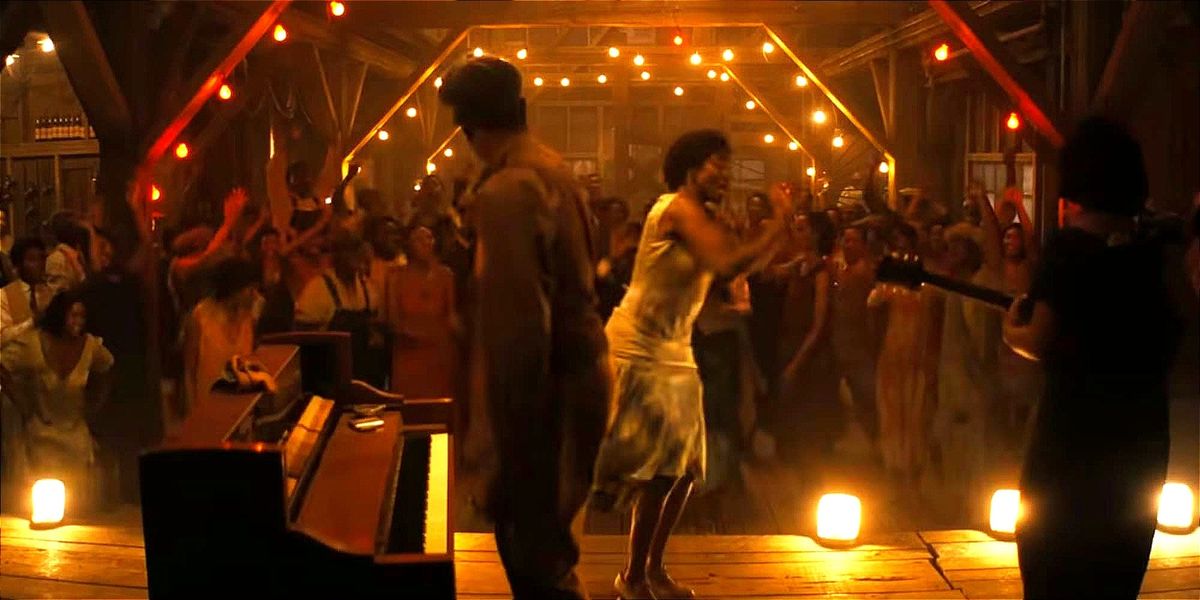
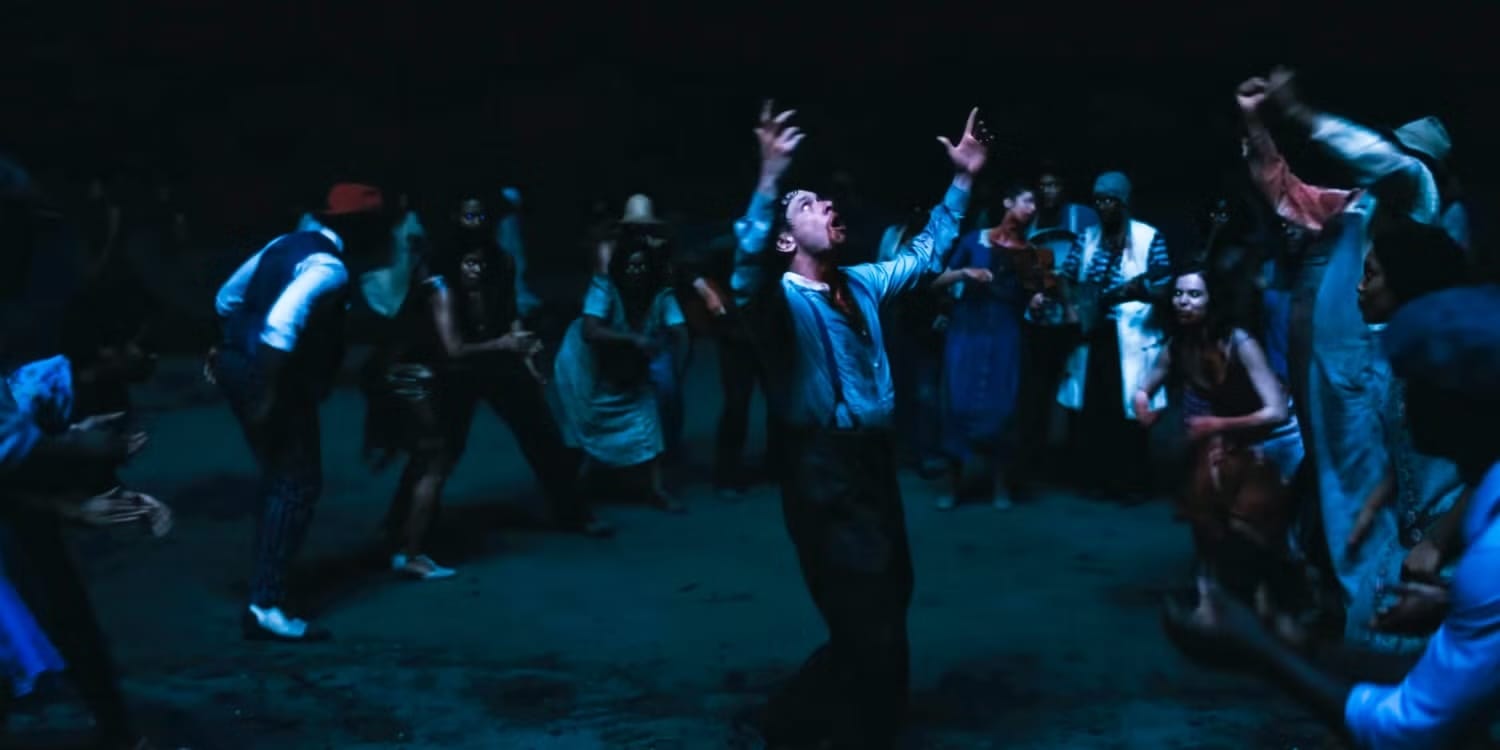
There’s a scene in “Sinners” (⭐ ⭐ ⭐ 1/2, but I'm still thinking about it) that levitated me out of my theater seat, through the roof and up to a drone’s-eye-view of human cultural history. If you’ve seen the movie, you know what I’m talking about. It comes as the juke joint that’s been inaugurated one hot Mississippi Delta night in 1932 comes alive to the sounds of a blues guitar and a man’s voice and the shuffle and stomp of 200 feet on a worn wooden floor. The musician is Sammie Moore (Miles Caton), who calls himself Preacher Boy after his disapproving Baptist daddy (Saul Williams), and he’s been told his guitar was once owned by Charley Patton, so there’s a ton of sin and salvation streaming through that steel resonator.
As he plays and the room explodes in ecstatic movement, figures out of time start winding through the throng: polyrhythmic West African shamans, Afrofuturist guitarists, a DJ turntabling the sound of the spheres, the shade of Hendrix conjuring electricity from his strings. The celebration moves beyond the confines of the Mother Continent to fold in a traditional Chinese dancer, because the town’s grocer (Bo Chow) and his wife (Li Jun Li) are there catering the affair, and their DNA is part of the new country’s secret sauce, too – a music created to express and transcend the suffering of strangers in a culture that only wants their labor. We’re watching an art and an idiom of the unwanted, one so aching for liberation – itself the sound of liberation – that it in years to come it would be taken up by the very people who doled out the suffering, as the only way they themselves thought they could feel catharsis and release. Soul music for a country unwilling to look too closely at its soul.
It’s an astonishing sequence, a moment of magical surrealism in a movie that until then has been strictly, almost fetishistically realistic, intent on recreating not just a time and a place but how that time and place were experienced by the folks at the bottom of America’s social scale. And it’s at that moment that “Sinners” – or, rather, it’s maker, writer-director Ryan Coogler – shifts us into the territories of tall tale and metaphor, horror movie and history lesson, for outside the juke joint is an army of vampires, led by a devil of an Irishman (Jack O’Connell, below) who only wants to riverdance to Preacher Boy’s tune, and why won’t they do the polite thing and invite him in?
There’s a lot to say about this movie. You can argue about whether it’s one of the year’s best – it’s certainly on my list – but there’s no question about it being the most ambitious American film of 2025 to date, commercially and thematically and artistically. Its box office success has resulted in head-scratching if not outright shock in the executive suites of Hollywood and in the pages of the entertainment press, because who could have thought a film that speaks this directly and entertainingly to an audience that understands exactly what it is saying would make $128 million in two weeks while dropping a fractional 6% from week one to week two? Aren’t American moviegoers supposed to be unquestioning vessels to be topped up with Marvel sequels and fake-buttered popcorn? When did people get so smart?
(To me, this confusion in high places sounds very much like the pundits and chattering TV heads currently assuring us that the majority of the country yearns for a political center when everything that leaks through the cracks of social media and the fury of a thousand street protests insists that, no, the thirst is for someone, anyone, in the halls of Washington or the meeting rooms of the media to see what’s happening and respond to or reflect it accordingly, as if the house were on fire and the vampires had crossed the threshold, which it is and they have.)
Among the many pleasures of “Sinners” – among which, I must confess, is the reach that sometimes exceeds its grasp – is the joy of ensemble. Actors coming together on a shared wavelength of a project that gets them antsy to work together: Newcomer Caton as a boy with the voice of a man (Blind Willie Johnson’s voice, specifically); Jayme Lawson as Pearline, a juke joint temptress of the sort that got Robert Johnson killed; Delroy Lindo, ever amazing, as the proud, profane street musician Delta Slim; Wunmi Mosaku – where did she even come from? – as Annie, keeper of myths and medicines and the only one there who knows a haint when she sees one (and also that vampires weren’t invented by Universal Studios or Bram Stoker but go way, way back to the Obayifo and the Asanbosam).
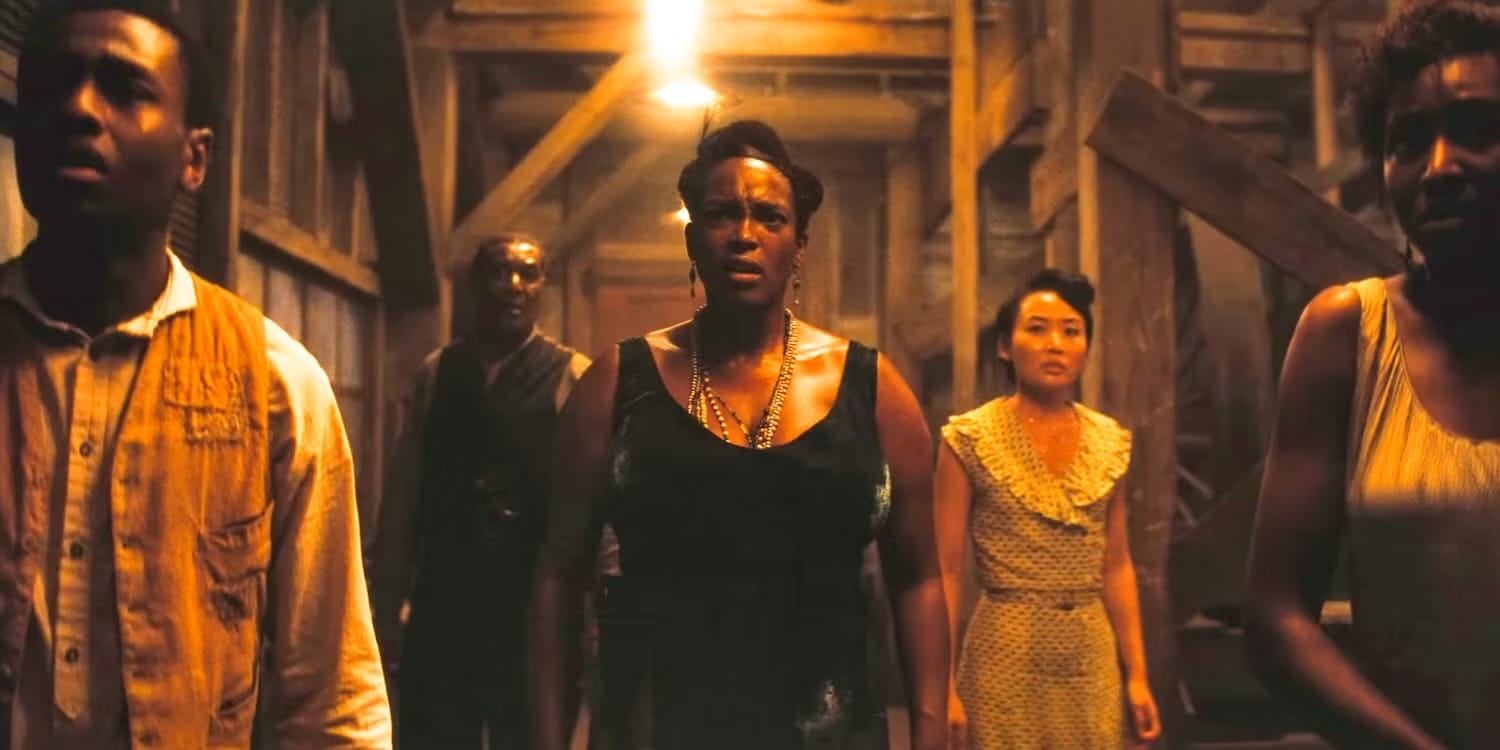
Hailee Steinfeld as Mary, who looks white enough to make a Black man scared to make eye contact with her at a train station but whose mother’s father was half Black, which makes her what they used to call an Octaroon, with her feet in two separate worlds, neither of which will easily accept her. Cornbread (Omar Benson Miller), who jumps up from fieldwork to block the door of the juke joint as the nicest bouncer you’ll ever meet. Whoever plays that old man – I think it’s Gralen Bryant Banks – who tries to buy his drinks in plantation scrip, which Smoke can’t abide and Stack won’t refuse.
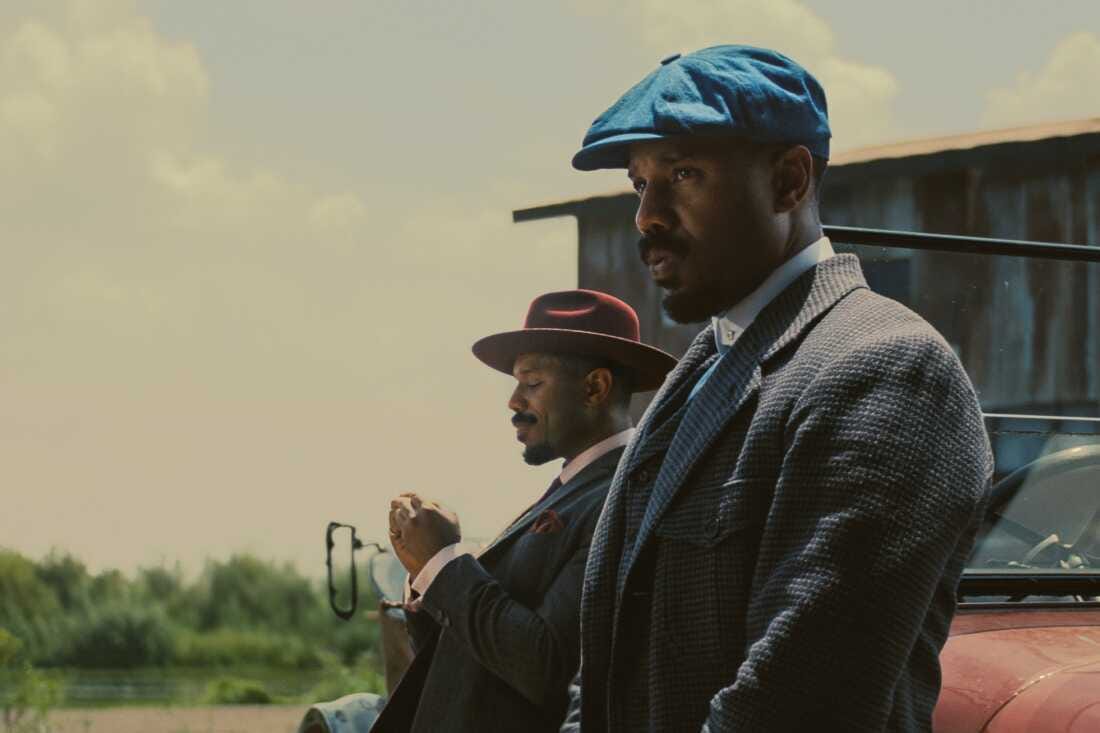
Smoke and Stack – two twin brothers, one hard and mean, the other grinning and garrulous, both played by Michael B. Jordan with body language that immediately distinguishes one from the other. They lean into the winds of Southern racism at different angles, with differing theories of resistance, but they fought in World War I and they worked for Al Capone up in Chicago, and they’ve come home to Clarksdale – the town where Robert Johnson sold his soul to the devil, remember – with a wad of dubiously earned money to … what? That’s one of the loose threads of “Sinners,” that Smoke and Stack would buy an abandoned slaughterhouse from a Southern cracker (David Maldonado), open up a palace of sin, and think they wouldn’t be calling down the devils from the campfires of the Klan, the speakeasies of the North, and the pits of Hell.
It's the vampires – the movie's midpoint turn to genre horror – that puts some people off the movie. But Coogler's speaking in the language of the parable and the midnight morality tale, and he's not delivering a TED talk. I imagine that on paper the script for “Sinners” resembled that conspiracy-crazy-wall meme, so many connections and intimations has Coogler wired into his movie. But coursing along beneath everything like a bright red river is the needed reminder (oh, let’s call it a fact) that the art(s) that came up and through slavery, that warped themselves to injustice and pain and the heady immediacy of juke-joint release, and that ultimately were absorbed by the enslavers as their art(s) and sold to the world as such – those arts belong to the people who suffered to create them, and all else is vampirism.
There aren’t many places in popular culture that acknowledge this. It’s not … nice, at least to white people. One of the few artifacts (to my knowledge) that confronts it head on is “Amnesia,” a song by the long-lived, much-loved British punk/folk/country group The Mekons on their 1989 album “Rock ‘n’ Roll” (a title that, in this case, positively drips with irony.)
To a driving rush of guitar noise and pounding drums, Mekons headman Jon Langford sings:
It was a dark and stormy night and the ship was rockin' on the open sea
Tossing and turning and rolling in our bunks the first mate the bos'n and me
From Bristol to the Ivory Coast then on to Jamaica
Down in the hold there is no sound, taking rock n' roll to America
There’s the mathematical formula of American popular music right there: When we dance to our favorite rock song or listen to the nostalgic soundtracks of our adolescence or cue up a treasured jazz album, we’re hearing the sounds of the Slave Triangle – art that wouldn't be possible without a legacy of racism and commerce. And, Langford further sings, we carry it forward as our music in America’s misadventures abroad:
Up the river wah-wah throbbing, heavy artillary
Blackface painted floodlit jungle gringo military
Any old army high on drugs fighting that rock n' roll war
Truth! Justice! And Led Zepplin! Heavy metal marine corps!
The music in “Sinners” predates rock and roll, of course, but it serves as rock’s bedrock – the double-helix in every white iteration from Elvis on down and with a history that goes back to minstrelsy and beyond. The film is (among many other things) a text soaked in the history of the Delta blues, its legends and confabulations, but it reminds a viewer that this was first and always a music that served as the expression (one of many) of real lives and real sorrows, and that its most subversive protest was insisting good times could still be had under the cruelest system of existence this country could conjure. That music – this music, made by and belonging to this people – was not meant to be sold to the overseers and bleached of life, because life was what it represented. The blues was a secret language, a fuck you to white America, and before the blues it was jazz, and after that it was R&B and rock ‘n’ roll all the way to hip-hop, which got boxed and sold to the world as American music, too, by the American vampires who loved it.
Bless-a my soul, what's wrong with me – I forgot to forget to remember, goes the nagging chorus to the Mekons' "Amnesia," and "Sinners" wants us to stop and think along similar lines, to stop forgetting to remember, even though every other piece of pop culture we produce depends for its profits on our amnesia. Coogler isn't asking a white audience to go home and melt down their vinyl albums or cancel their Spotify accounts (I think). But he does invite that audience across the threshold and sends them home with a door prize, which is a series of questions they can’t and shouldn’t shake. Where does this music come from? What is my relationship to it? Can I claim it as “mine”? And when I listen to it, what am I making sure to not hear? (For Black audiences, I imagine, this is nothing they don't already know but rarely get to see put over with such unholy brio and craft.)
You’ll have your own answers, maybe. I do know that when I got home from “Sinners,” guitars and brimstone ringing in my ears, I put on a “history of the blues” playlist I made a few years back, music that touches me with a power I don't get anywhere else. And when I looked in the mirror, I no longer saw my reflection.
Feel free to leave a comment or add to someone else's.
Please forward this to friends! And if you’re not a paying subscriber and would like to sign up for additional postings and to join the discussions — or just help underwrite this enterprise, for which the author would be very grateful — here’s how.